UPSC Mains 2026: Last-Week Preparation Strategy, Exam Structure & Answer-Writing Tips
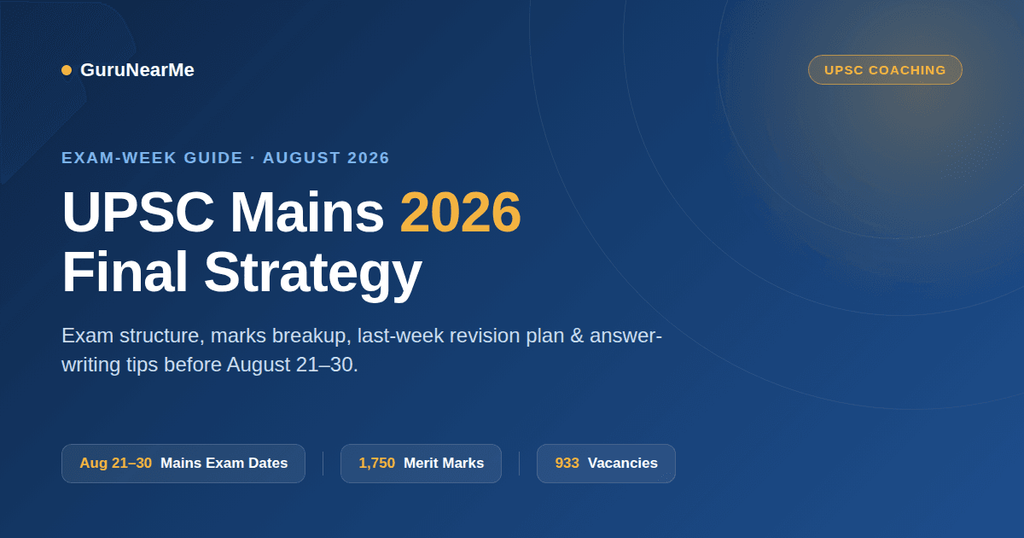
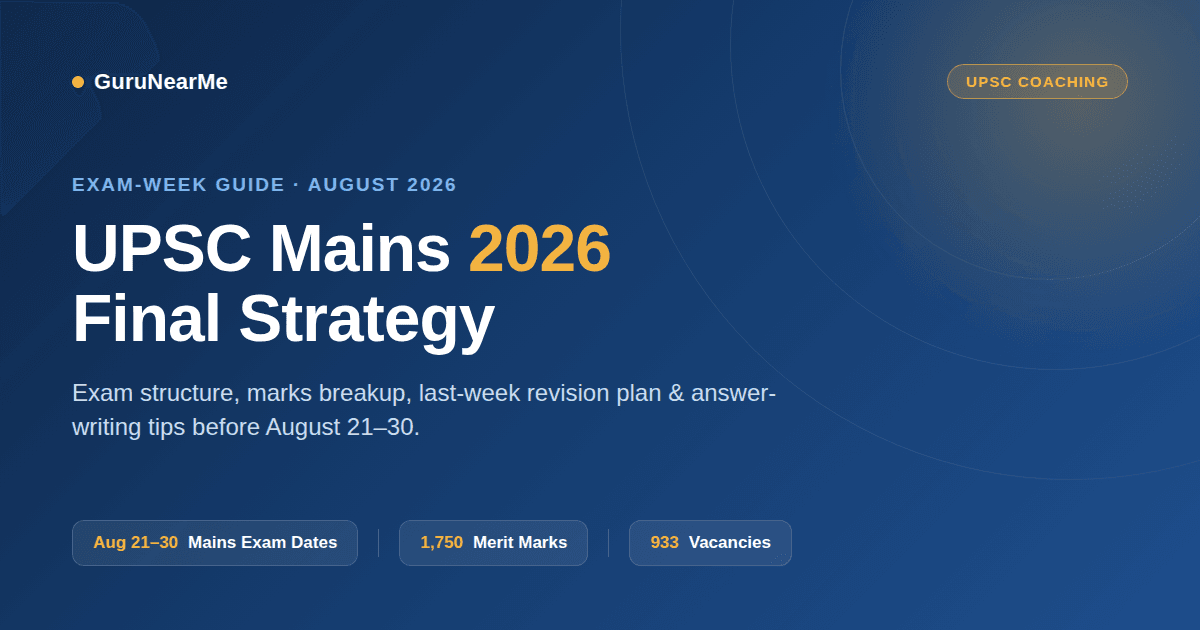
The UPSC Mains 2026 exam runs from August 21 to August 30, across two weekends, and more than 13,000 candidates who cleared the Prelims on June 15 are now in the final stretch of preparation. If you're one of them, the next seven days matter more than almost any other week in your UPSC journey — not because there's time to learn new syllabus, but because there's still time to convert what you already know into marks.
This guide breaks down the exact UPSC Mains 2026 exam structure, a realistic last-week revision strategy, and answer-writing tips that examiners consistently reward.
UPSC Mains 2026: Key Dates at a Glance
- Prelims exam: May 24, 2026
- Prelims result: June 15, 2026 (13,343 candidates qualified from 5.49 lakh who appeared)
- Mains exam: August 21–30, 2026 (five exam days across two weekends; forenoon session 9:00 AM–12:00 PM, afternoon session 2:30 PM–5:30 PM)
- Vacancies notified: 933
- Interview and final result dates: yet to be announced by UPSC
UPSC Mains 2026 Exam Structure and Marks Breakup
Understanding exactly where your marks come from changes how you spend your remaining days. The Mains exam has nine papers, but only seven of them count toward your final rank.
| Paper | Subject | Marks | Counts for Rank? |
|---|---|---|---|
| Paper A | Compulsory Indian Language (8th Schedule) | 300 | Qualifying only (25% minimum) |
| Paper B | English | 300 | Qualifying only (25% minimum) |
| Paper I | Essay | 250 | Yes |
| Paper II | General Studies I — History, Geography, Society, Heritage | 250 | Yes |
| Paper III | General Studies II — Polity, Governance, IR, Social Justice | 250 | Yes |
| Paper IV | General Studies III — Economy, Environment, Science & Tech, Security | 250 | Yes |
| Paper V | General Studies IV — Ethics, Integrity, Aptitude | 250 | Yes |
| Paper VI | Optional Subject Paper 1 | 250 | Yes |
| Paper VII | Optional Subject Paper 2 | 250 | Yes |
That's 1,750 marks across the seven merit papers, plus 275 for the interview — a grand total of 2,025 marks that decide your final rank. Paper A and Paper B only need to clear a 25% qualifying threshold, so don't let last-minute anxiety about your language paper eat into GS or Optional revision time.
Last-Week Revision Strategy: Recall, Not Re-Reading
With exam day days away, re-reading the same notes for the fourth or fifth time has diminishing returns. The candidates who score well in this final stretch shift from passive reading to active recall.
Build keyword sheets, not chapter summaries. For every major topic, condense your notes into 8–10 retrievable anchors — a constitutional article, a Supreme Court judgment, a committee name, a statistic, a quotable line. A good example that was read once but never revised for retrieval almost never makes it into the answer sheet under exam pressure. The goal this week is retrieval speed, not fresh information.
Revise through writing, not highlighting. Pick a topic, close the book, and write a 150-word outline from memory. Then check it against your notes. This single habit exposes exactly which "known" topics you can't actually reproduce under time pressure — and that gap is far more useful to find now than on August 21.
Protect your last 48 hours for consolidation only. No new sources, no new current affairs compilations, no new optional-subject material. Use this window purely to skim your own keyword sheets and static-portion summaries.
Answer-Writing Tips That Actually Move the Needle
Presentation gets attention in coaching classes, but content depth and precision are what move your score. A few habits separate high-scoring answers from average ones:
Answer exactly what's asked — no more, no less. If a question has three parts, address all three explicitly rather than writing a general essay around the theme. Partial answers to multi-part questions lose marks even when the writing quality is strong.
Use your own understanding, not a memorized template. Rigid, one-size-fits-all answer structures often flatten genuinely good points into generic filler. Let the specific question dictate the structure — introduction, body with substantiated arguments (data, examples, committee recommendations), and a forward-looking conclusion — rather than forcing every answer into the same mold.
Practice full three-hour mock tests, not isolated answers. Writing twenty answers in isolation doesn't train the same muscle as writing twenty answers back-to-back in one sitting under time pressure. Full-length simulations reveal fatigue patterns, question-selection strategy, and whether your handwriting and speed hold up in the final hour — problems you want to discover this week, not on exam day.
Managing Exam-Week Mindset
Every Mains candidate faces the same unsettling moment: an unfamiliar question that no source seemed to cover. The candidates who handle it well go in with a specific mental frame — I do not need to know everything, I need to use what I know intelligently. You've already cleared one of India's most competitive filters just to sit for this exam; the Prelims result is proof the preparation has worked so far.
In the final week, protect sleep, meals, and basic physical activity as seriously as you protect study hours. Cognitive recall — the entire game in Mains — degrades fast under sleep deprivation and stress, no matter how thorough your notes are.
Get Structured Support for the Final Stretch
A focused mentor or answer-writing evaluator can catch blind spots that self-study alone often misses — structural issues in your answers, weak time allocation, or optional-subject gaps you haven't noticed yet. If you're looking for UPSC coaching, mentorship, or an answer-writing evaluator near you for this final stretch, you can browse verified UPSC coaching centres and mentors on GuruNearMe and connect with someone who can review your practice answers before August 21.
This article is part of GuruNearMe's UPSC Coaching resource series, tracking exam dates, syllabus changes, and preparation strategy for competitive exam aspirants across India.